
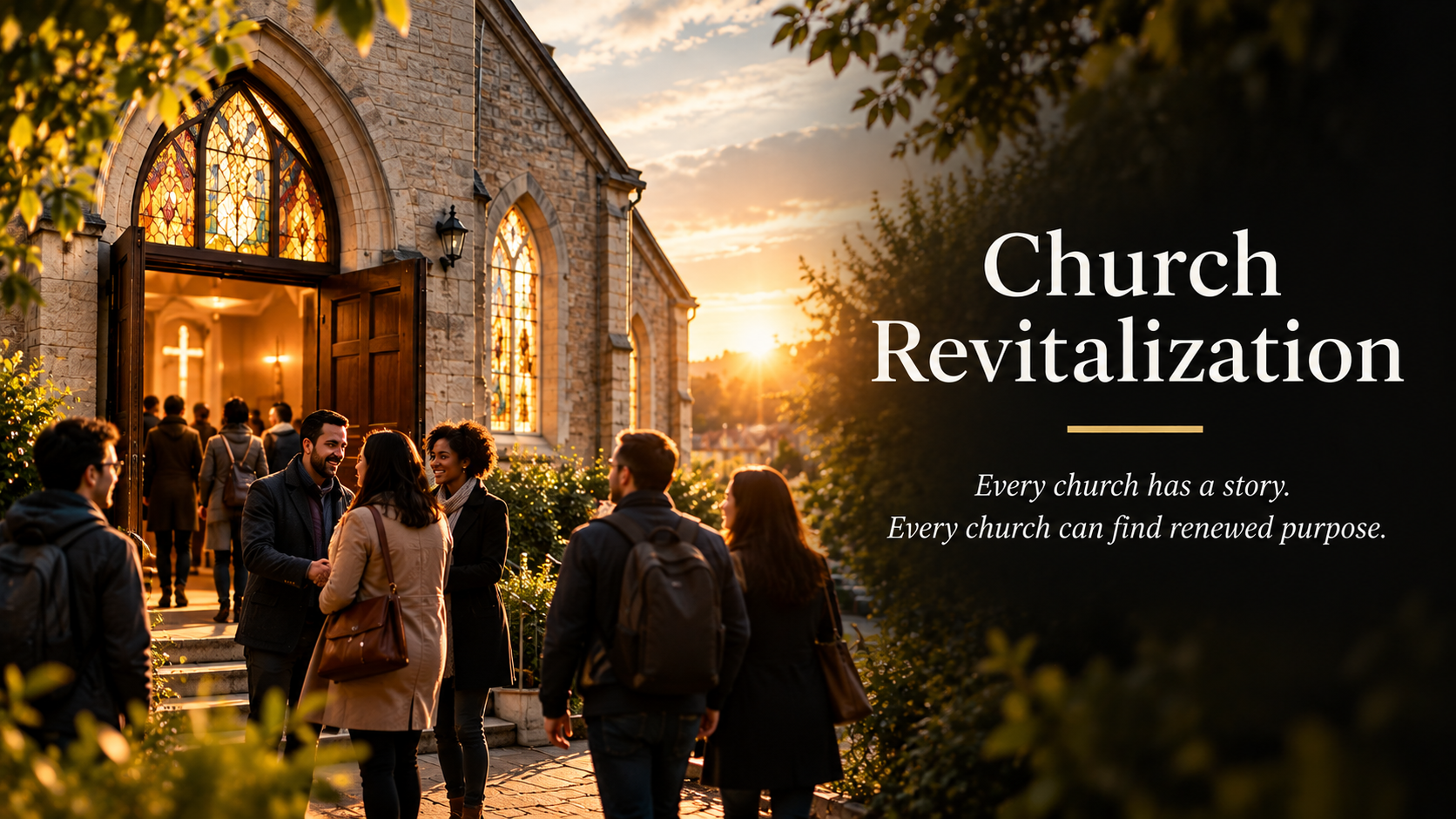
Church revitalization
Church revitalization is central to my theological reflection and an important part of my ministry. It involves working alongside congregations seeking to renew their spiritual vitality, missional engagement, and community life, helping them discern the paths of renewal that God may open.
In a context of secularization and profound social change, many churches face new challenges. Church revitalization invites them to return to what matters most: the Gospel, the mission of God, and the Church’s calling to make disciples who make disciples.
Understanding Church Revitalization
Church revitalization is not simply about increasing attendance, multiplying activities, or adopting new methods. Above all, it seeks renewed spiritual vitality and a clearer understanding of the Church’s calling.
A revitalized church rediscovers its identity in Christ, its calling to participate in the mission of God, and its responsibility toward the people and the context in which it is established. Revitalization therefore touches every aspect of church life, including spiritual growth, community, mission, and the Church’s engagement with its surrounding environment.
It is a journey of discernment, renewal, and transformation that requires an honest assessment of the church’s current reality, while prayerfully listening to the Word of God and seeking the paths He may be opening for its future.
Why Churches Need Revitalization
Churches serve in contexts undergoing profound change. Secularization, cultural shifts, changing social realities, and generational transitions can weaken their community life and their ability to bear witness to the Gospel.
Some churches experience declining engagement, spiritual vitality, or missional momentum. Others continue their activities but struggle to connect with the people around them. These situations invite congregations to take time to discern what is really happening and to reflect on their calling.
Church revitalization provides an opportunity to face these realities honestly, not to condemn the efforts of the past, but to seek how the Church can once again live out its calling fully within its own context.
My Understanding of Church Revitalization
I understand church revitalization as a process of returning to what matters most: rediscovering who we are in Christ, gaining a renewed understanding of the Church’s calling, and discerning how to participate in the mission of God within our own context.
Every church is unique. Its history, culture, members, context, and challenges are different. It can be tempting to adopt a method or model that has worked in another church, but revitalization cannot simply reproduce what has succeeded elsewhere. It requires a process of discernment to understand the reality of each congregation and identify the path that best fits its particular situation.
I see the revitalizer, in some ways, as a physician working with a church. Before recommending a treatment, a physician seeks to understand the situation, identify the difficulties, examine the symptoms, and make a diagnosis. In a similar way, a revitalizer works alongside a church through a process of listening, assessment, and discernment, seeking the most appropriate responses to its circumstances.
The approaches may therefore differ from one church to another, but the foundation remains the same: Jesus Christ and the Gospel. Revitalization is not about searching for new formulas, but about pursuing a journey of renewal rooted in Christ, enabling each church to rediscover its calling and participate fully in the mission of God.
My Approach to Church Revitalization
Church revitalization begins with listening. Before seeking solutions, it is essential to take the time to understand a church’s history, its current situation, its strengths and vulnerabilities, and the context in which it is called to bear witness.
My approach begins with a process of assessment and discernment carried out alongside the church’s leaders and members. Together, we seek to identify the main challenges, recognize what God is already doing within the congregation, and discern its priorities for the future.
Building on this process, the church can gradually develop a renewed vision and define directions suited to its particular situation. The aim is not to impose an external model, but to work alongside the congregation so that it can discern, embrace, and implement the changes it needs.
Church revitalization also takes time. It is not a short-term program, but a process that generally unfolds over several years. Depending on the church’s situation, this journey may extend over two to three years, allowing time for meaningful discernment, transformation, and ownership of the process by the congregation.
My Experience in Church Revitalization
My pastoral experience has gradually led me to develop a particular interest in church revitalization. Through my ministry at the Armenian Evangelical Church of Valence, I have had the opportunity to work toward renewing the life of the church, its spiritual vitality, its mission, and its engagement with the surrounding community.
This experience has helped me understand more deeply that revitalization requires time, listening, discernment, and the involvement of the entire congregation. It has also led me to reflect more carefully on how a church can rediscover its calling, develop a renewed missional vision, and make disciples who make disciples.
My experience in Valence continues to shape my thinking and my approach to working alongside other churches as they pursue their own journey of revitalization.
An Ongoing Revitalization Process
I am also currently involved in an ongoing church revitalization process. This involves taking the time to listen to the congregation, understand its history, its current situation, and its wider context, and discern together the paths of renewal that God may open.
This process involves a gradual journey of assessment, discernment, and reflection on the church’s identity, calling, and mission. It also provides a practical context that informs my ongoing reflection on the challenges of revitalizing historic churches in a context of secularization.
My Research in Church Revitalization
My training in practical theology deepens this hands-on pastoral experience. As part of my Master’s degree at ITF – Presbyterian College in Montreal, my research focuses particularly on the revitalization of historic churches in a context of advanced secularization.
This research brings theological reflection, contextual analysis, and pastoral experience into dialogue, helping me develop a deeper understanding of how churches can rediscover their missional calling and renew their presence within their local contexts.
Helping a Church Find Renewed Vitality
Church revitalization ultimately leads to an essential question: How can a church fully live out its identity in the context where God has placed it?
It is not about returning to the past or simply reproducing what works elsewhere. It is about helping a church reflect on its history, understand its present reality, and look toward the future in the light of the Gospel.
A renewed church is not necessarily one that does more, but one that rediscovers a clear understanding of its identity, its mission, and its responsibility toward the people around it.
This is how I understand church revitalization: a journey of renewal rooted in the Gospel, oriented toward mission, and shaped by the unique reality of each church.